

Sara’s story highlights how our family systems can shift and adapt to meet the dynamic needs of it’s members - if we are flexible and embrace these changes. Sara supported her mother through her cancer diagnosis and treatment while simultaneously absorbing the caregiving tasks required to care for her grandmother. Upon her mom’s death, Sarah moved her grandmother in upstairs, and experienced intergenerational caregiving under the same roof, all while raising two young kids. Sara, the creator of The Overwhelmed Yogi, speaks to the benefit and necessity of bringing movement into our day-to-day, particularly when we are experiencing layered stressors with work, parenting, and caregiving.
When Support Systems Rearrange
Lissy: Can you speak to when you first realized that you were in the sandwich generation?
Sara: Well, I guess the first thing was that motherhood, before I got to taking care of anybody else, was much more overwhelming than I expected it to be. My older son went to the NICU when he was born, and he was fine. But looking back now, it put my nervous system into such a state of fight or flight. And I really had trouble getting out of it.
I had just thought, I’m gonna become a mom, and I’ll be able to work a little less, and still have my career…I was both a yoga teacher and a journalist, and I had been a freelancer for a while before that, so I was sort of juggling a lot of balls at any given time. And I just assumed that I would be able to go back to all of that while being a mom, and that was very unrealistic.
Lissy: I mean, I think we don’t know until we’re in it.
Sara: No. But at that time, my mom and my grandma were a huge support to me. I would also say that there were a couple of pieces in place. One, my husband is a pediatrician who works huge hours. I love and respect that about him, but somebody who had a partner with part-time flexible hours, it might not have been as difficult. And then in journalism, you have to be available whenever someone calls you back. So, that was also a very hard career option with a baby.
But my mom and my grandma were coming to New York from Connecticut, they would come every Thursday morning and sleep over until Friday. My mom was sort of taking care of my grandma, they lived together, but they were both support, and that was 2 days a week of childcare for me.
And then, when my older son was 3, and my younger son was 1, my mom got cancer. She was a yoga teacher, and you would have thought she would have died on a mountaintop at 105. She was a picture of good health and vitality and all the right habits, and it didn’t matter. So, that year was just a whirlwind of helping to take care of her, and to do some things for my grandma. But there were a lot of hands on deck at that time.
It was just so overwhelming to me that I’m not sure if I thought of the term sandwich generation, I just thought: I have to do all of this. My mom died in May of 2018, when my kids were 2 and 4. And then my grandmother, who had lived with my parents and was completely reliant on my mom, I wanted her to come and live with us.
There were a lot of places she could have lived. It wasn’t that it was the only option. She could have stayed with my dad. She could have stayed with her son. There were a host of adoring nieces and nephews who would have taken her, but everybody felt that for her to survive the loss of her daughter, being with great-grandchildren was the best option.
My sister, at that time, didn’t have any kids. She lived in Brooklyn, I’m in Queens, and she was very involved in coming over and helping however she could. She also did a lot during our mom’s chemo, because I couldn’t be at all of the treatments, with little kids.
So in the summer of 2018, my grandma moved in upstairs, at 92-years-old. We got a second apartment upstairs. We were in a small enough apartment that it wasn’t physically possible for her to be in the apartment, but she was right upstairs, and I had two little kids, and so then I was very squeezed. And that lasted until she died in November of 2020. So that included the beginning of the pandemic. And we were living in the epicenter, the epicenter of the epicenter was Queens, and my husband was working in our neighborhood hospital, so it was an incredibly stressful time.
Lissy: Yeah. I mean, hearing about your experience, what I think is really interesting is that these are the things that you can’t really plan for. The idea that your mom is caring for your grandma, and then your mom is the one that gets sick. It kind of defies expectations in a way that then can leave you scrambling.
And make it even harder to show up for your mom when she was sick, when you’re also thinking about all of the things that she was doing for your grandma that now somebody needs to do, if she’s knocked out by chemo, or not feeling well, or at the end of her life, you know?
Sara: One day we were trying to figure out how to sort my grandmother’s 8 different medications, and my mom was the only one who knew how. And she was dying and not able to talk to us about it. It was very hard.
Lissy: Yeah, it just makes a really difficult thing even more complex.
Sara: Yeah. For the last 5 years, I’ve been working on a memoir about that period of time. I took notes throughout the whole thing. And I’m still a mom with two young kids, and my dad had first been diagnosed with prostate cancer in 2010. My mom also took care of him during his initial treatment, and then last summer we learned that his prostate cancer had metastasized, and that came at the same time as my sister’s son was born. So, he started chemo in January, right at the time of my nephew’s birth, so clearly my sister was not in a position to take him to treatment, so I have done that. She’s helped an infinite other ways. I think one great blessing through all this is how we have supported each other, which I know not all siblings have.
His chemo has been challenging, but a walk in the park compared to what my mom went through. We’re actually on a break from chemo now, after 13 rounds, which is great. We’re not sure yet what’s next. He’s just getting monitored right now. But the chemo generally involves waking up at 4 o’clock in the morning, and there’s usually 4 to 5 people that I’m in communication with to fill in for a day of me not being here. My kids are at two different schools, they have after-school activities, the dog needs walks.
Lissy: How old are your kids now?
Sara: They’re 9 and 11. One’s in elementary and one’s in middle school. They’re old enough that they have their own social calendars and activities. But not old enough that they can make plans for themselves.
Lissy: Yeah. I imagine reaching the point where your kids want to take some control of how they’re spending their time feels really cool, but then also they don’t have the logic and reasoning skills to understand what is perhaps a reasonable or unreasonable plan?
Sara: Yeah, and it’s just a lot to coordinate logistically.
The Unexpected Benefits of Caregiving Under the Same Roof
Lissy: Yeah. What was it like when your grandma moved into your building? What was it like for your family dynamic, and how was it for your kids?
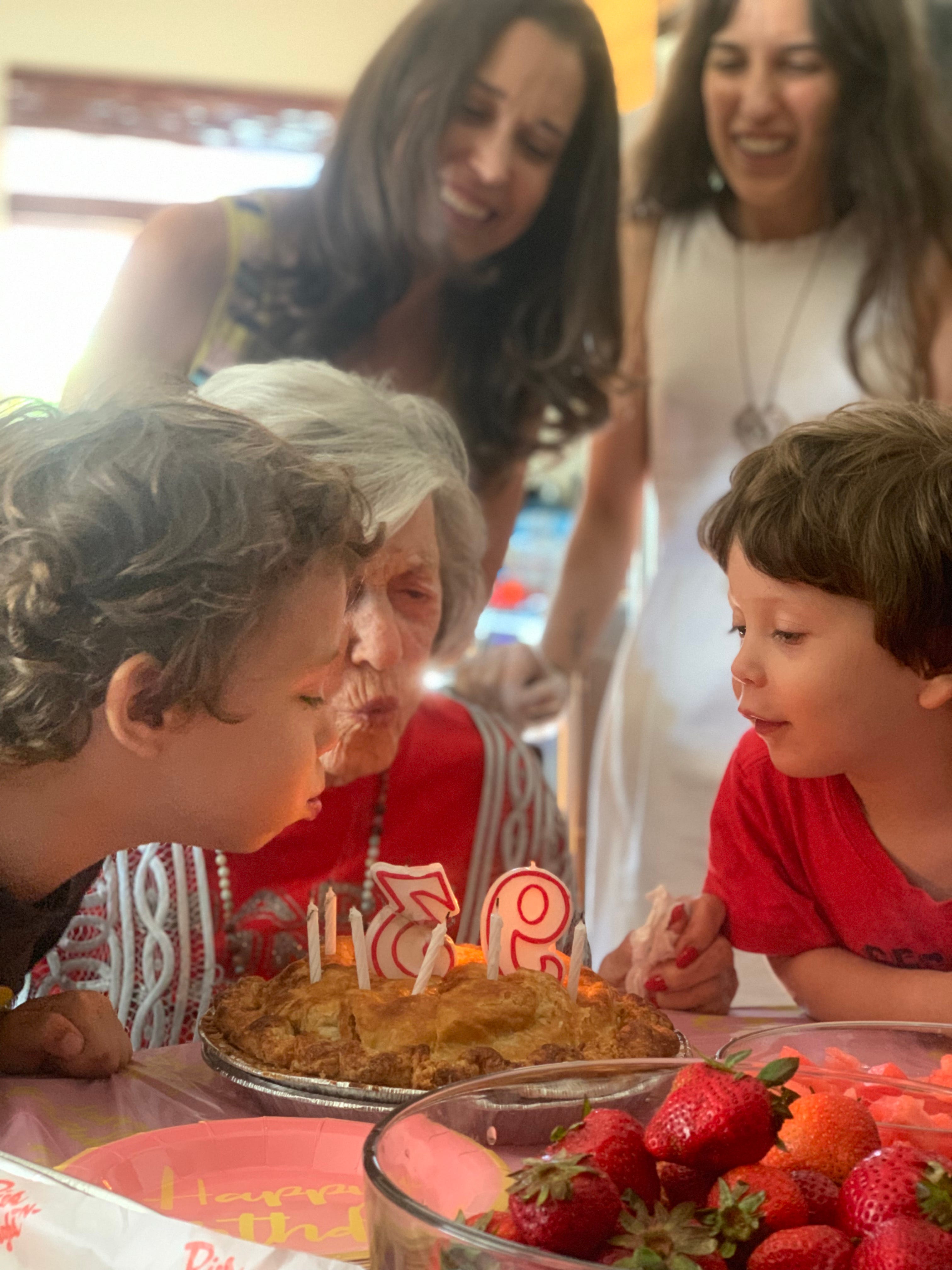
Sara: Everybody called her Bubbi. I did, they did. My husband was amazing in not blinking an eye when I was like: your grandmother-in-law is coming to live with us. My younger son was only 2 at the time, so he didn’t have a huge understanding of what happened, but my 4-year-old was really sad that his grandma had died, and he knew that she was really sad that her daughter had died. And so we wanted to be together with her. She showered them with the kind of love and attention that I often wished that I could. While I was frantically cooking and cleaning up after everybody and making the plans, and sorting the pills, she would just sit and read to them for hours at a time, and that was a beautiful thing.
It also was a beautiful thing for them that she was like the matriarch of the family. She had been the youngest of five siblings, and she was the last surviving one. She had all kinds of nieces and nephews, as well as friends who would come to visit, and her son came to visit from Boston all the time. So my kids got a real experience of a big extended family.
A few years later, when my younger son got to kindergarten, there was an assignment where he was asked to draw a picture of his family, and I think they just meant the people who live with you. And he drew 16 people. So that was beautiful. It was also stressful on me to be hosting all the time. And one thing that was sort of funny in retrospect, though it didn’t feel funny in the moment, was that my grandma had a bit of dementia, and people would call and tell her that they were coming, and she would forget to tell me.
So one thing, from a super practical standpoint, is she had long-term care insurance. That was a godsend. Because I was able to use that. They covered an overnight aid. Because I was worried about her falling, when she would get up to go to the bathroom all night long, and I was worried about her falling if she was upstairs and I was downstairs.
And then only 4 months after she moved in with us, she got placed on hospice, because she had a night of vomiting, and we brought her to the emergency room, and they found a mass in her pancreas. We declined a biopsy, because it would have been such an invasive procedure, and she was already 92. But they thought it was conclusive enough that they put her on hospice. I think it was benign, because she lived another 2 years after that. But hospice covered a certain number of hours of a daytime aid, which also became a godsend, especially once the pandemic started and I was homeschooling on top of it. She eventually got kicked off hospice for living too long.
But I think for people who are looking ahead, she had paid into that long-term care policy for many years. You can’t just decide you’re going to pay into it, and then you’re going to cash it in the next day. But I think it’s a really valuable thing for everybody to think about, because that made our living arrangement possible.
Lissy: Yeah. And I also think it’s something that is not really on your radar until you have somebody you care about who has it, and you see how useful it is, and then it feels crucial. But I think it’s something that can be overlooked, when people are doing their planning. I’m glad you were able to rely on that, especially thinking about you being able to sleep at night.
Sara: I did very little sleeping in those nights, but yes.
Lissy: I hear that, and it would have been even worse if you were also feeling she was alone up there, you know?
Sara: Yes. A thousand percent.
Delayed Grief and the Importance of Movement
Lissy: I’m wondering, because I think part of what I’m hearing is that when your grandma moved in, it was like: you’re grieving your mom. And then your grandma moves in, and it’s almost this symbol of your mom’s absence, having her with you.
Sara: She was an extension of my mom in many ways. And I feel I didn’t really grieve my mom until after my grandmother had died, because I was in such overdrive taking care of everyone, that I never really allowed myself to just sit and cry and process it much. Little bits, but not to the extent that I needed to.
Lissy: That totally makes sense. And I think it’s both emotional and then also just from a timing perspective, it’s like, okay and when would I do that? That makes sense, that it’s this kind of delayed process, and I think that happens so often for folks, where the grieving process happens when your body recognizes that you have space to hold it.
I’m wondering what you found helpful; what were the things that you relied on?
Sara: For me, movement and exercise have always been huge, which is why I have the offering that I do. My mother and I were both yoga teachers. I went through a ton of stuff in my own body that required me to scale way back on my yoga practice for a long time. But I do find that what I’m offering publicly is what I’ve used myself to get through this. If you can just find two minutes to do a stretch or do a breathing exercise, or something to help settle your nervous system, it is so much better than nothing. Exercise in various forms. I love meditation also, but if I’m being honest, when I could only fit in one, I will do some kind of movement. I find both the mental benefits of that, and my body had been through so much that I really needed to move to not be in pain.
Lissy: That makes sense. And I think depending on the type of exercise and movement that you’re doing, it can be meditative in itself to be able to drop into your body in that way, you know?
Sara: Absolutely. And fresh air. It’s remarkable how hard it is sometimes with little kids just to get everyone outside, but it makes such a difference.
When Conflicting Needs Arise
Lissy: Were there things that weren’t available to you, that you wish you could have had? In terms of support or access to certain resources?
Sara: This is a little tangential, but I had a horrible case of diastasis recti that turned into an umbilical hernia and needed to be operated on. I mean, I was teaching other yoga teachers, and I didn’t know what it was. And so much of what we do in yoga is contraindicated for it, but also I had every risk factor for it, and my OB never told me about it, and I was literally walking around with my guts hanging out, and so my low back was killing me. To add that on top of the caregiving burden was really a lot.
Lissy: You were experiencing chronic pain related to motherhood, happening at the time when you’re also taking on these caregiving roles. And it’s just that thing that happens to women so often, where it’s just: you’ll be fine, it’s just part of it, carry on. And so often there is an actual thing happening that does need to be addressed, but we’re often given this messaging that it’s just all a part of the process, and so then I think when you’re stretched so thin and trying to do a million things at once, it can fall into the background, where all of a sudden you’re just living with chronic pain.
Sara: I actually had an abdominal surgery, for the hernia and the diastasis when my younger son was 1. And it helped for about a month, and it didn’t work. The doctor wanted to go back and operate again, and that coincided with my mom’s cancer diagnosis. There was just absolutely no way. And for a variety of reasons I don’t think I would have wanted to anyway, but then I literally for a time had that sports tape holding my abdomen together, and that was as much as I could do for myself.
Lissy: What a perfect representation of where you were at. That’s really brutal.
Sara: But for sandwich generation caregiving, I think our whole society is just not really set up to support it, and I do think as more people are having kids later, and as people are living longer, there are more parents like me, who are taking care of their own parents at the same time as their kids are young. Historically, sandwich generation caregiving has been perceived as: your kids go to college, and now you have to take care of your elderly parents. But there are more people who are needing to do the child-rearing and the elderly caregiving at the same time.
Lissy: I think you’re totally right, and I’m so thankful that you’re turning your experience into a memoir, because I think this is the way we help people realize this is people’s reality so frequently. It’s not this tiny segment of the population tucked over there. It shows up in all these ways, but it’s almost inevitable, if you are choosing to have kids and have the experience of having your parents live longer.
The Challenges of Ongoing Caregiving
Lissy: Thinking about your dad’s treatment, and how you’re so many years into this journey, and it’s still ongoing: what are the routines or the practices that you’ve used to support yourself in this chapter of your sandwich generation journey?
Sara: I should say, my dad has a lot of friends who have been incredible to him, and he lives in Connecticut, which is an hour and a half, two hours away. He could have come to New York to be with us, but he wanted to stay in his house. The days of his chemo have been exhausting, but there are many days in between that I’m just living my life as a mom. Of course, my sister and I both check in with him through text or the phone every day, but it’s not the same as having somebody living with me.
After a chemo day, I will often feel that I need a couple days just to recover, because it’s so tiring. The planning in advance of how it’s going to work, even just packing our food for the day, because we’ll be in the hospital for 7 hours, and hospital food is not the best. I’ll sit there with his walking stick stretching my shoulders, and I take him to the bathroom, and I wait for him in the hall, and I will grab onto the bar and be doing a squat from it.
Lissy: I love that so much. Every time I get your email in my inbox with the suggestion of the day for the way to bring movement in, I just think: yes, this is how people actually will incorporate this into their day-to-day, if they can just be in between meetings, and do one little thing.
Sara: I mean, even think of a best-case scenario where you could do a full workout, or go to the gym, or go to a 90-minute yoga class, which I used to do before I had kids. And I am at a place in my life that I’m lucky I do go to a gym 3 times a week. But even then, your stress accumulates all day long. So if you work out for an hour, and best case scenario, you’re going to work out again for an hour tomorrow morning, you still have 23 hours in between that life is coming at you. And taking little breaks for stuff like this is helpful.
Lissy: Totally. People are so inclined to want to check the box, rather than having it be this ongoing…
Sara: Part of your day… yeah.
Lissy: I think about it similarly to mindfulness, which is something that I incorporate in my work as a therapist, that it’s not just a 20-minute meditation. Sure, that’s part of it, but part of it is also noticing…
Sara: What you bring into the whole day..
Lissy: …how the whole day feels, and how you work within it, noticing what is showing up in your body, and being connected in that way. I love that you do that stuff when you’re with your dad. I think that’s so important, to be able to sustain yourself through those long days, knowing that even if you do those things, it’s gonna take a lot out of you.
Sara: Yeah. One thing that’s hard, I think, for a lot of us at this time of the year, is kids get sick all the time, and when you’re taking care of an older person with a compromised immune system, you can’t be with them if your kid has the flu or the norovirus, or whatever. That’s tough.
Lissy: That’s so hard. And I’m remembering some of the people in my life who are medical professionals, and the protocols that they would go through to enter the house after a shift in the early days of COVID…
And you guys, with having young kids, having the intergenerational immune system struggles, I mean,
Sara: It’s big, and I don’t think it’s talked about nearly enough.
Lissy: It’s so hard.
A Mindful Legacy to Share
Sara: I love that I have my mom’s meditations available to share. That was actually how my email newsletter started, I brought it over to Substack a few months ago. I had known before my mother died that she taught meditation for 4 years at Yale Law School. I did not know until after she died that the classes were all recorded.
The day of her funeral, one of her students came up to me with a flash drive. And all of the recordings were on there. I was blown away. For a while, my newsletter was once a month, and every month I would send out another one of her recordings. Many of my subscribers are her former yoga students. But the sound quality on a lot of them is not so good. So it sort of got to the point where I was thinking, you know, I love to hear her voice, and the people who knew her well loved to hear her voice, but I want it to be something that’s more generally helpful. So my friend who’s a podcast editor, sound edited 10 of the fan favorites, and that’s what’s available now on my Substack.
Lissy: Oh, that’s so awesome.
Sara: It just means a lot to me to have that. I also have a playlist that she’s made for me of specific practices that are mentioned in my book, and someday when my book comes out, that will be available, too. For now, there’s 10 of them on my Substack, with excellent audio quality, thanks to my friend Victoria.
Lissy: That’s really special. I can only imagine the emotional experience of receiving that flash drive. What a gift to be able to access that.
Sara: I didn’t even realize it. She handed me a little gift bag and a card, and she said there’s something in here you’re going to want to see. And I was in such the throes of bringing my grandma to live with us that it took me a month before I had even gone to open everything that we got, and realized what this was, and I was blown away.
Lissy: It’s so special.
Sara: It’s called, Let My Mom Teach You to Meditate, and it’s so special. Yeah, it’s been a special thing to be able to offer people. And I love it when people who didn’t know her just enjoy the meditations just for their own sake, it makes me happy that her voice is still out in the world.
TL;DR: Biggest Takeaways and Reflections for Caregivers
Raising young kids while caregiving is the new normal: as people have children later in life and older adults live longer lives, a huge segment of the population finds themselves in the sandwich generation. If this is you, you are not alone.
Caregiving does not need to equal conflict: engage in meaningful, honest dialogue with your siblings about caregiving in a proactive, intentional way. It is possible to show up for one another with clarity and connection. Looking for a place to start? Try here.
Sara’s mom’s meditations are available on Sara’s Substack: incorporate them into your day for a moment of mindfulness.
The power of small movement: yes, it’s important to go to that weekly exercise class. And it’s also immensely impactful to bring in purposeful movement throughout your day. Check out Sara’s Substack, The Overwhelmed Yogi, for attainable ways to bring movement into your daily life.
Resources to consider: long-term care insurance
Consider becoming a paid subscriber to receive resources, scripts, and tools straight to your inbox.
Know someone who might resonate with this interview? Give them the virtual hug of sharing this interview.
If you are interested in 1:1 coaching and resources to help you feel confident in how to navigate your time in the sandwich generation, please reach out to me through my coaching website, Sandwich Support Co, at the link below.